Wondering when to plant grass seed? Short answer: late summer through early fall for cool-season grasses — the lawns of the northern United States and nearly all of Canada — and late spring through early summer for warm-season grasses across the South. Sown in the right window, the same bag of seed establishes faster, roots deeper, and faces far fewer weeds.
Below you'll find the best time to plant grass seed for every US and Canadian region, the soil-temperature numbers that take the guesswork out, and a proven fallback if the calendar has already gotten away from you.
What is the best time to plant grass seed?
The best time to plant grass seed is mid-August to early October for cool-season grasses (Kentucky bluegrass, fescues, perennial ryegrass) and late spring to early summer for warm-season grasses (Bermuda grass, zoysia, centipede). Cool-season lawns can also be seeded in spring once soil reaches 50–65°F; warm-season seed needs soil of 65°F or warmer, per University of Maryland Extension and Oklahoma State University Extension.
| Grass category | Best window | Second-best window |
|---|---|---|
| Cool-season (northern US, Canada) | Mid-August – early October (UMD Extension) | Spring, once soil holds 50–65°F (UMD Extension) |
| Warm-season (southern US) | Late spring – early summer, soil 65°F+ (Oklahoma State) | Up to about July 1 (Oklahoma State) |
Exact dates shift with your climate. Jump to the regional table to fine-tune for your area.
(North US & Canada)
(Southern US)
Why timing matters more than technique
Seed sown in the right window lands in warm soil with steady moisture and weak weed competition, so it sprouts quickly and roots before stress arrives. The same seed sown off-window sits in cold ground, washes out in storms, or germinates straight into heat and crabgrass.
Nebraska Extension turf specialists put it plainly: fall brings less weed pressure than spring, and the stretch of cool, rainy weather from September into November is ideal for young cool-season grass. Your seeding date sets the whole germination window — soil temperature, moisture, and day length all follow from it.
Timing decides whether new grass establishes at all. How quickly it comes up once sown is a different question — our guide to how long grass seed takes to grow walks through that side.
Cool-season or warm-season: know your grass first
Cool-season grasses grow hardest in the mild temperatures of spring and fall and dominate the northern US and virtually all of Canada. Warm-season grasses peak in summer heat and rule the South. Your grass category — not your zip code — decides which seeding calendar you follow.
Cool-season species: Kentucky bluegrass, tall fescue, fine fescues, perennial ryegrass, and low-maintenance fescue blends such as Eco-Lawn low-maintenance grass seed.
Warm-season species: Bermuda grass, zoysia, centipede grass, buffalo grass.
Between the two belts runs the transition zone — roughly the mid-Atlantic west through Kansas — where summers punish cool-season lawns and winters bite warm-season ones. Turf-type tall fescue is the usual compromise there, and it follows the cool-season calendar.
Gardening north of the border? Canada sits almost entirely in cool-season territory, from Victoria to St. John's, so Canadian readers can follow the cool-season windows throughout this guide.
When to plant cool-season grass seed (Northern US & Canada)
Cool-season grass seed establishes best in late summer and early fall, when soil is still warm, nights are cooling, and autumn rain is on the way. Spring is the backup. Here's exactly when to sow grass seed in each window — including the calendar edges worth respecting.
Fall — the best window (mid-August to early October)

If you're deciding when to plant grass seed in fall, work backward from your first hard frost and leave at least 45 days of growing time. Nebraska Extension calls August 15 to September 15 the prime window for its region and warns that every week of delay costs two to four extra weeks of fall maturing time. In the milder mid-Atlantic, University of Maryland Extension stretches seeding from mid-August to mid-October — but no later, because November frosts damage young seedlings.
Fall wins on physics: summer-warmed soil speeds sprouting, cool air is gentle on seedlings, and most annual weeds have already quit for the year. In Canada, prairie lawns should wrap up by early September, while coastal BC's mild autumn stretches the window to mid-October. Seeding also slots neatly beside your other autumn jobs — compost topdressing, raking, and the rest of the natural lawn care supplies checklist.
Spring — the runner-up window (soil 50–65°F)
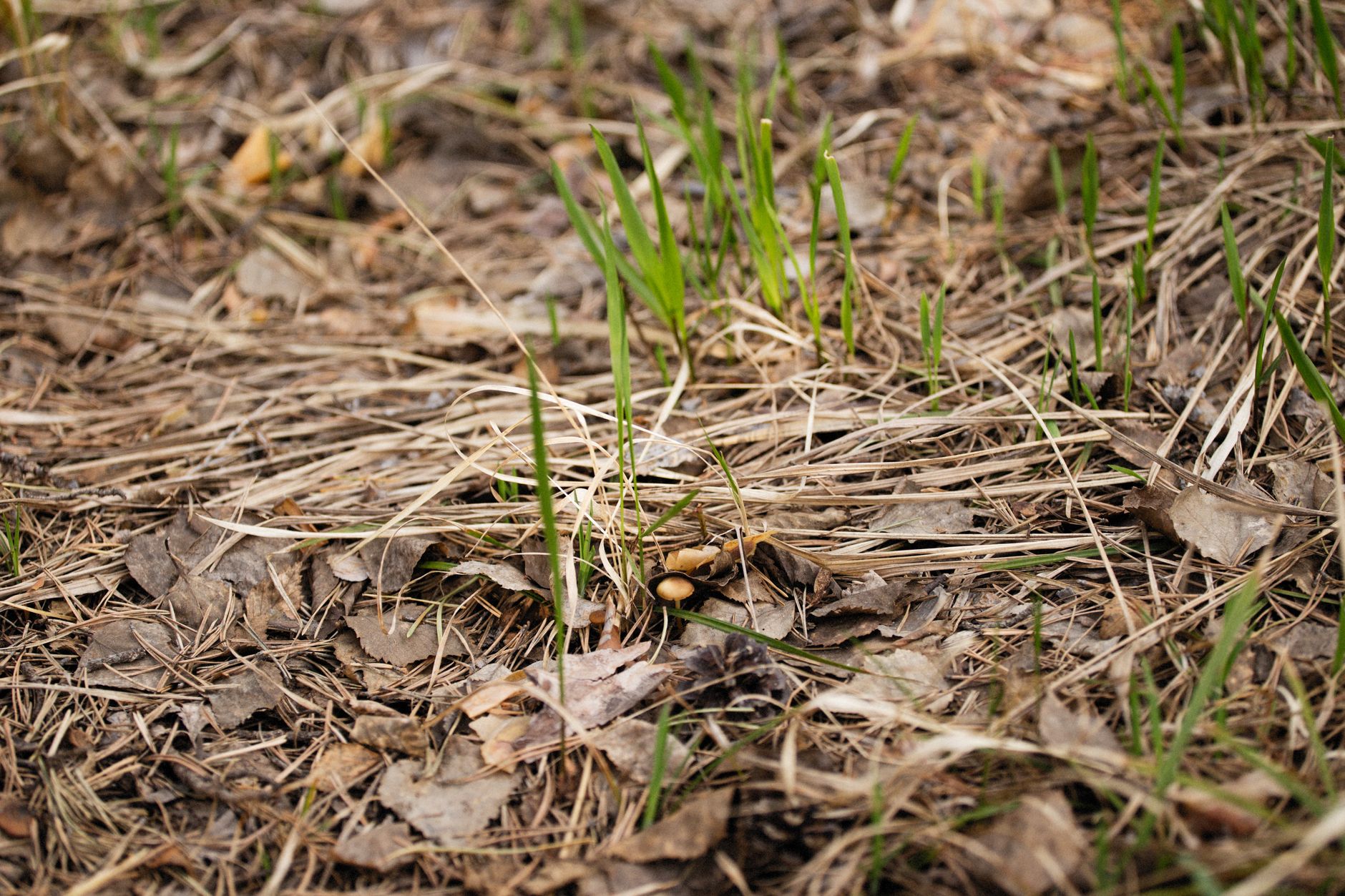
For anyone weighing when to plant grass seed in spring: wait until soil holds 50–65°F — the range where cool-season grasses grow best, per University of Maryland Extension. That's typically mid-April to late May in the northern US and much of Canada, or as early as March in the southern transition zone, which Oklahoma State rates the second-best seeding month after fall.
The trade-offs are real. Spring seedlings share the seedbed with germinating crabgrass and broadleaf weeds — University of Minnesota Extension lists heavier weed pressure as a core drawback of off-peak seeding — and summer heat often arrives before roots run deep. So the best time to plant grass seed in spring is as early as the soil allows, giving roots a head start on July.
From my own yard — a spring seeding in the Pacific Northwest
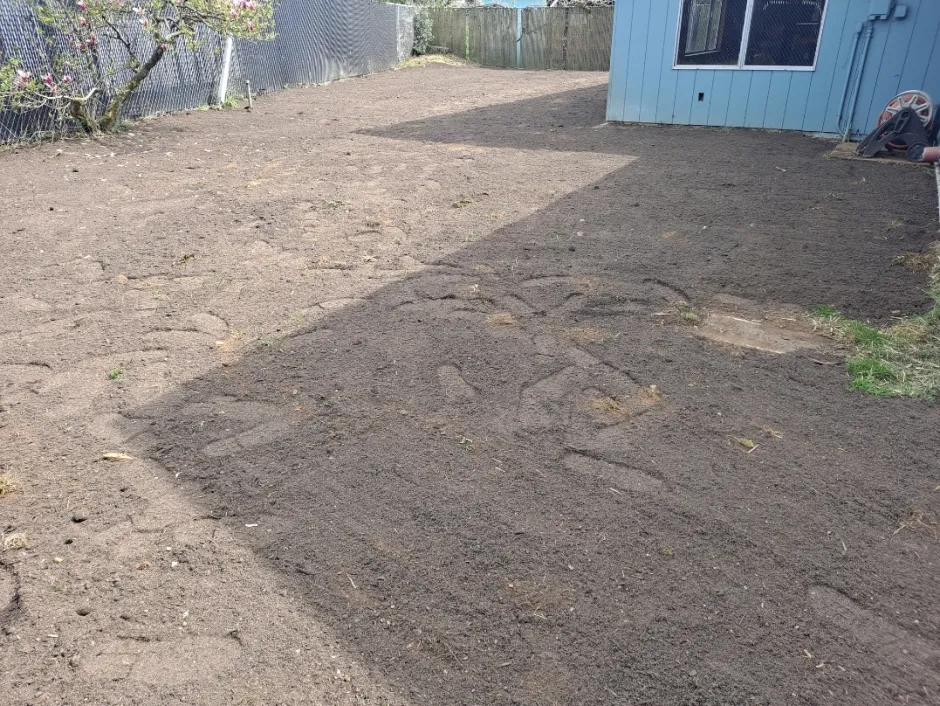
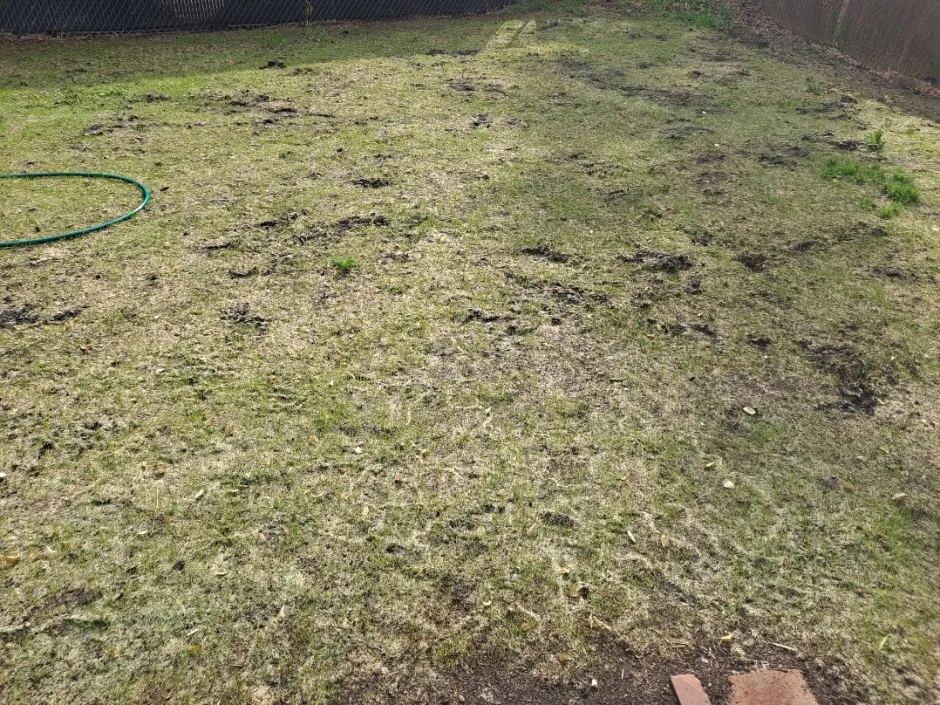
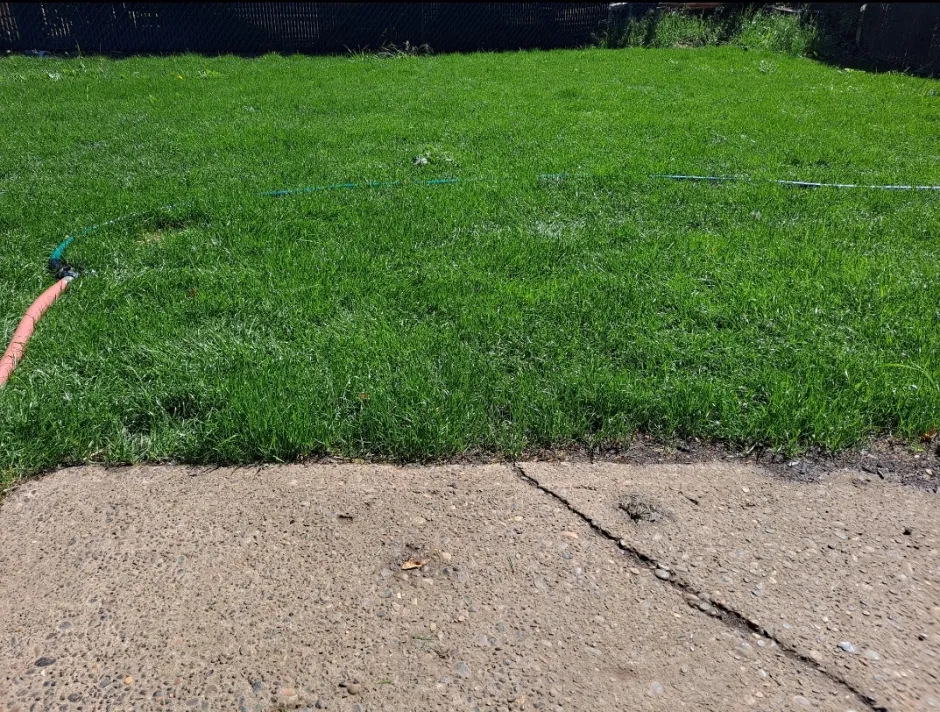
After grading our backyard for proper drainage in the spring of 2021, our entire lawn had to be replanted. The contractors applied hydroseed, a liquid slurry containing a blend of Kentucky bluegrass, perennial ryegrass, and fescues. They urged us to keep it moist around the clock — even a short dry spell would inhibit growth.
Even with mild Pacific Northwest weather and some rain on our side, we were surprised just how long it took to see significant progress — and by how often we had to water. I can't imagine we would have been able to keep up in warmer weather, which is exactly the trade-off that makes spring the runner-up window rather than the best one.
We were encouraged to see the first sprouts emerge in a matter of days, but it was nearly a month before we saw anything resembling a real lawn. The bright green hue of the hydroseed was slowly replaced by an evergreen carpet, at which point we still kept foot traffic light for several more weeks. Our patience paid off: we were able to enjoy our lush yard that summer, and with overseeding it has only gotten better with time.
One caveat if you're sowing from a bag: hydroseed slurry holds surface moisture better than seed raked into bare soil, so a conventional spring seeding usually demands more watering attention than the timeline below, not less.
When to plant warm-season grass seed (Southern US)
Plant warm-season grass seed in late spring to early summer, after the last frost, once soil is reliably 65°F or warmer. Oklahoma State University notes Bermuda grass seed won't germinate in soil below about 65°F and calls May 1 through June 15 the optimum planting stretch.
An early-summer sowing gives these heat lovers a full growing season to knit together before their first winter dormancy. Don't push much past midsummer: Oklahoma State's lawn establishment guide advises seeding most Bermuda varieties by July 1, and NC State Extension brackets the whole warm-season seeding season between March 1 and July 1, depending on species and location.
Species notes, briefly: Bermuda grass sprints from seed once soil warms. Zoysia is slower and steadier, with the same July 1 cutoff in Oklahoma State's planting tables. And centipede grass creeps in gradually, so early sowing matters even more.
When to plant grass seed by region
Here's when to plant grass seed across the US and Canada. Find your region, confirm your grass category, and pencil in the best window — with the backup in case life intervenes.
| Region | Grass category | Best window | Backup window |
|---|---|---|---|
| United States | |||
| Pacific Northwest (west of Cascades) | Cool-season | Late Aug – early Oct | Mid-Apr – May |
| California (coastal & northern) | Cool-season | Sep – Oct | Mar – Apr |
| Southwest (low desert & southern plains) | Warm-season | May – mid-June | Through July 1 |
| Midwest & Great Plains | Cool-season | Aug 15 – Sep 15 | Late Apr – May |
| Northeast | Cool-season | Mid-Aug – late Sep | Apr – mid-May |
| Southeast | Warm-season | May – June | Mar – Apr (coastal south) |
| Transition zone (mid-Atlantic to Kansas) | Cool-season tall fescue | Late Aug – early Oct | Mar |
| Canada | |||
| BC coast & Vancouver Island | Cool-season | Sep – mid-Oct | Apr – May |
| Prairie provinces | Cool-season | Early Aug – early Sep | Late Apr – May |
| Ontario & Québec | Cool-season | Mid-Aug – late Sep | Late Apr – May |
| Atlantic provinces | Cool-season | Mid-Aug – early Oct | May |
These windows follow the university guidance above — Minnesota and Nebraska for the northern tier, Maryland and NC State for the mid-Atlantic and South, Oklahoma State for warm-season country. To sharpen them for your street, look up your average first and last frost dates: NOAA's freeze-date tables cover the US, and Environment and Climate Change Canada's climate normals cover Canada. Then apply the 45-day rule from the fall section.
What soil temperature does grass seed need for planting?
The right soil temperature to plant grass seed is 50–65°F for cool-season species and 65°F or warmer for warm-season species — figures from University of Maryland Extension and Oklahoma State University. Soil, not air, is the trigger that matters.
Checking is cheap: push an inexpensive soil thermometer about 2 inches (5 cm) into the lawn and read it in the morning, when soil sits near its daily low — Wisconsin Extension suggests early-morning readings as the planting guide. Repeat over several days; one warm afternoon doesn't make a trend, because soil warms and cools far more slowly than air.
Soil temperature also governs how fast seed sprouts once it's down — our companion guide on germination covers that side of the equation.
When is it too late to plant grass seed?
For cool-season lawns, it's too late to plant grass seed once you're inside 45 days of your first expected hard frost; for warm-season lawns, past midsummer. Nebraska Extension calls mid-September the critical cutoff for tall fescue in its region, while University of Maryland Extension draws the line at mid-October — November's killing frosts damage seedlings that haven't rooted.
Push past those dates and you're gambling. Late-sown seedlings winterkill, bare seed washes downhill in cold rains, and whatever survives limps into spring weaker than seed you'd have sown in April anyway. On the warm-season side, Oklahoma State sets a July 1 deadline for Bermuda grass so plants can establish before winter.
Missed everything? You still have one honest option.
Missed the window? Try dormant seeding
Dormant seeding means sowing after soil drops below 40°F — cold enough that seed absorbs water but stays asleep until spring, as University of Minnesota Extension explains. In the northern US and Canada that's roughly November through March; Nebraska Extension recommends spreading seed from mid-November onward. It shines on bare patches, where winter freeze-thaw cycles tuck seed into the soil for a head start you'd never get waiting for a soggy April.
Can you plant grass seed in summer or winter?
Can you plant grass seed in summer? You can, but it's the costliest route: seedlings fight peak heat, weeds, and drought, and survival depends on constant watering. University of Minnesota turf researchers advise waiting rather than seeding in June or July. All that irrigation is money and water poured into fighting the calendar — wait a few weeks and the calendar starts working for you.
Can you plant grass seed in winter? Only as dormant seeding, described above. Seed scattered on frozen or snow-covered ground in the hope of quick sprouting will feed birds and wash away; seed sown deliberately into sub-40°F soil (UMN Extension) waits out winter and germinates when spring soil warms.
When should you overseed an existing lawn?

The best time to overseed a lawn matches the best time to seed one: late summer to early fall for cool-season lawns, late spring for warm-season — and when in doubt, a season earlier beats a season later. Overseeding is the right call while your lawn still holds more than half its good turf, per Nebraska Extension; thinner than that and a full renovation makes more sense.
Pair fall overseeding with aeration. Nebraska's turf team recommends several aerator passes first, since new seed only takes where it touches bare soil. Overseeding also calls for roughly half the seed rate of a bare-ground job — the grass seed calculator has an overseeding mode that does that math for your exact lawn size.
How much grass seed will you need?
Once you know when to seed, the next question is how much. Our free grass seed calculator gives you the exact pounds for your lawn size and grass type — new lawn or overseeding — so you buy one bag, not three, and nothing gets wasted.
Calculate how much seed you need →FAQ — quick answers about grass seed timing
Should I plant grass seed before or after rain?
Before a light rain is perfect — gentle moisture settles seed into the soil and saves you a watering. Before a downpour is a mistake, especially on slopes, where runoff carries seed into puddles and gutters. After heavy rain, let the surface dry to crumbly before you sow.
Is fall really better than spring for cool-season lawns?
Yes — for a cool-season lawn, fall is the best time to plant grass seed. It offers summer-warmed soil, mild air, reliable rain, and dying weed competition — Nebraska Extension notes far less weed pressure then — and fall seedlings bank two cool growing seasons before facing their first summer. Spring grass gets one, with crabgrass for company.
How long will the seed take to come up once planted?
Anywhere from under a week to a few weeks, depending on species and soil temperature. Timing your sowing well shortens the wait; our guide to how long grass seed takes to grow breaks down what to expect and when.
What if I want a lawn I barely have to mow or water?
Seed a low-maintenance blend in the same fall window. Deep-rooted fescue mixes shrug off drought once established — see our first-hand guide to planting an eco-lawn in fall — or consider a clover lawn that skips mowing almost entirely.
Is seed or sod better if I'm starting late in the season?
Sod buys you time: it can be installed through much of the growing season, while seed needs its 45-day runway before frost (Nebraska Extension). Our seed or sod comparison weighs cost against speed.
